|
$$PLAIN_TEXT_PREVIEW$$
|
FEBRUARY 2026 NEWSLETTER
Edition 03
|
|
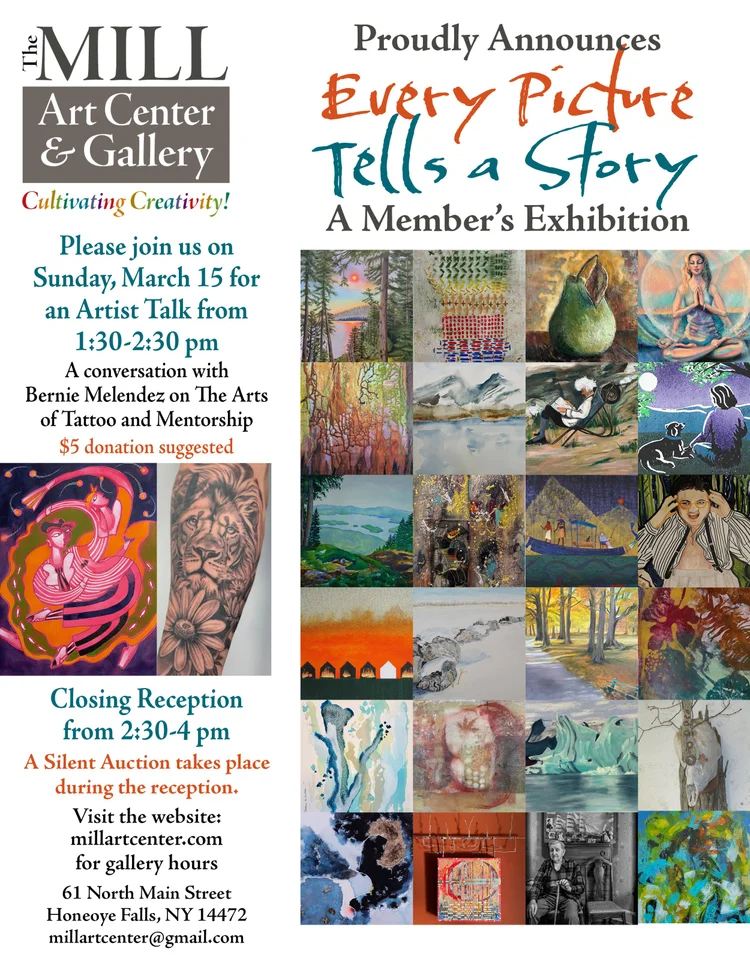
Dear Members of the Mill Art Center and Gallery, Our current exhibition, Every Picture Tells A Story, is yet again another excellent display of quality art. Please make every effort to visit. Our gallery hours are: Thursdays, 11am to 3pm Fridays and Saturdays 12 to 5pm Sundays 1 to 4pm As you know, the weather wasn’t the best for our opening reception, so we will be having a Closing Reception on March 15th after Bernie Melendez’s artist talk with Bill Stephens. During the Closing Reception, we will be having another Silent Auction, including new works from members as well as works from the archives. The auction will be taking place in the classroom. If you come to the Closing Reception, you may take your painting with you after the reception is over. Please see the attached image with full details on the talk and reception, and we look forward to seeing you then. Stay Warm and Well, Kathryn Bevier
|
|
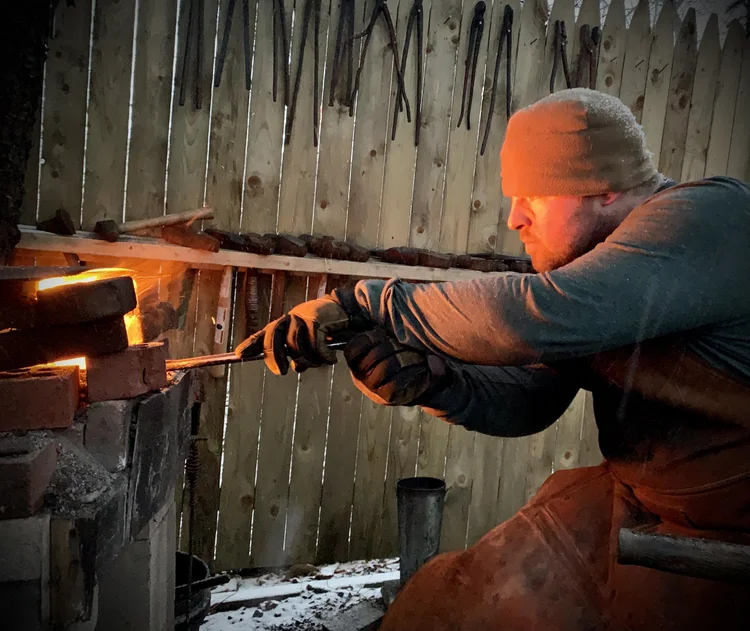
Friday, February 27th, from 5 to 6pm, Ben Spangler of Spangler Forge will give an Artist Talk on his profession as a blacksmith, where you can peruse his many examples of his craftsmanship.
—
Saturday, February 28th, from 10am to 5pm, Ben Spangler of Spangler Forge will hold a sales event in the gallery featuring his collection of hand forged blades made with traditional blacksmithing techniques and modern science. Free and open to the public.
|
|
Sunday, March 15th, from 1:30 to 2:30pm, a guided conversation on the arts of tattoo and mentorship with artist Bernie Melendez and Bill Stephens.
|
|
Sunday, March 15th, from 3 to 4:30pm, the Closing Reception for Every Picture Tells A Story and Silent Auction.
|
|
Thursday and Friday, March 19th and 20th, from 10am to 2pm, and Saturday, March 21st, from 10am to noon, are the Pick-Up dates for Every Picture Tells A Story (please take note of the times). Also, please do not pick up your art before Sunday, March 15th.
|
|
Saturday, March 28th, from 3 to 5pm, is the Opening Reception for the Rochester Area Fiber Artists Exhibition.
|
|
Thursday and Friday, May 8th and 9th, from 10am to 2pm, and Saturday, May 9th, from 10am to 12pm, are the Drop-Off dates for our next members exhibition - Musically Inspired. Guidelines forthcoming.
|
|
Our faculty and class offerings keep growing. Please have a look at our website to find a class or open studio for you. If there is a class you would like to see offered, please let me know. Looking for a way to give art or art lessons to someone? We have Gift Certificates, too. Here is the link.
|
|
You are invited to the artist reception for Robin McCondichie and Jean Stephens for their exhibition, Hidden Connections, on Friday, March 6th, from 5 - 7pm, at The Dove Block Project in Geneva, NY.
|
|
Peggy Kehoe is currently exhibiting at Axom Home in the Southwedge.
|
|
“Take a Mill Moment” is an invitation to pause. Each issue encourages our members to slow down and spend a few mindful minutes engaging with past histories as well as new ideas and fresh stories.
|
|
“Art is not what you see, but what you make others see.” - Edgar Degas
Before stories were written in books, they were expressed through spoken words, being shared in epic poems, sung by traveling bards, or passed down from one generation to the next through cautionary tales and folklore. Once oral traditions moved from voice to image, artists began translating narrative into visual form. Yet every time a story is pictured, it changes. Composition, color, and location can transform meaning.
Few myths capture this evolution more captivatingly, or more fittingly for the month of February, than the love story of Bacchus and Ariadne. What begins as a tale of betrayal becomes one of devotion. Bacchus not only rescues Ariadne, but he also marries her and grants her immortality, casting her jeweled crown into the heavens where it becomes the constellation of Corona Borealis. It is a story of second chances, of love found after loss, an enduring reminder that heartbreak can give way to unexpected joy. In Roman frescoes from Pompeii, Ariadne often appears asleep, vulnerable in her abandonment, while Bacchus approaches gently, the scene quiet and anticipatory. In mosaics from Volubilis and Ostia Antica, the mood is celebratory with the couple surrounded by festivity and abundance. Even during antiquity, visual emphasis determined emotional meaning: sorrow transformed into love’s triumph. In the sixteenth century, Tiziano Vecellio, more commonly referred to as Titian, infused the myth with electrifying emotion. Bacchus does not cautiously approach Ariadne in Titian’s rendition. Instead, he leaps toward her in a dramatic arc as the stars of Corona Borealis sparkle above, foreshadowing Ariadne’s eternal place in the heavens. The story becomes a divine declaration of love so powerful that it alters fate itself. Painted during the Renaissance, the scene reflects a culture fascinated by passion, beauty, and human emotion. Years later, eighteenth-century artists such as Sebastiano Ricci and Johann Georg Platzer softened the narrative into airy elegance using pastel tones and graceful figures to shift the focus from abandonment to enchantment. The myth becomes an allegory of romantic rescue, perfectly aligned with Rococo ideals of love and pleasure. In contemporary interpretations, such as the 2014 theatrical designs of Erik Teague for the Glimmerglass Opera production of Ariadne in Naxos, the story once again adapts, blending classical mythology with modern sensibilities while still retaining its emotional core. Across centuries, Bacchus and Ariadne’s story has been retold not only in words but in color and composition. In some images, we see heartbreak; in others, we witness ecstatic union. The transformation itself is the message. Every picture tells a story, but the artist decides whether we dwell on loss or celebrate love. As February invites reflection on different expressions of love and devotion, this ancient myth reminds us that love can arrive unexpectedly, that joy can follow sorrow, and that sometimes the most enduring Valentine is not written on paper, but in the stars.
|
|
|
|